
Introduction: The Third Green Revolution
Smart Agriculture and IoT are paving the way for what can be called the Third Green Revolution. Following the advancements brought about by genetics, as well as earlier practices such as selection, crossbreeding, and variety creation, the Third Green Revolution focuses on revolutionizing agricultural operations. In particular, this revolution is based on the combined application of data collection and analysis technologies.
IoT Technologies in Agriculture
Applications primarily utilizing wireless sensor networks (WSNs) assist farmers in monitoring and accessing current and historical information regarding the status of their fields. For example, such networks encompass weather stations, soil moisture sensors, flow and volume sensors for water, fire detection, and GPS receivers. These tools allow farmers to make informed decisions and manage their crops more effectively.
The Role of Autonomous Vehicles and Drones
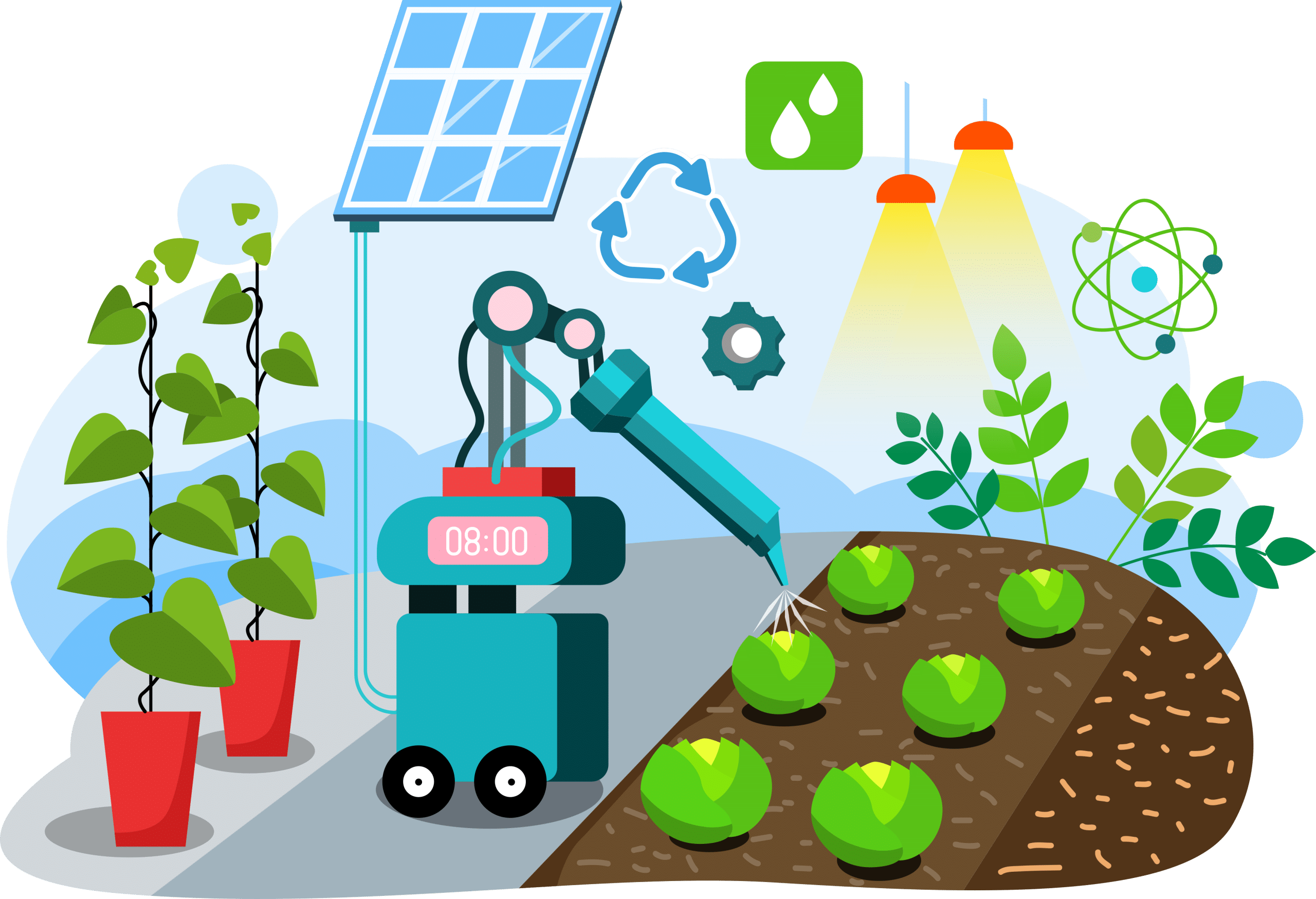
Moreover, autonomous robotic vehicles utilize this data to facilitate a multitude of tasks for farmers, including seeding, irrigation, and harvesting. In addition, autonomous drones execute preprogrammed or dynamic routes for the purpose of surveillance or real-time monitoring. These technologies not only reduce the need for human labor but also increase precision and efficiency in agricultural operations.
Environmental and Economic Benefits
The implementation of these technologies will bring significant environmental benefits, such as more efficient water usage and reduced reliance on pesticides and fertilizers. At the same time, overall productivity will increase. Thus, IoT technologies will enable enhanced food traceability, which will lead to improved food security.
The Future of Smart Agriculture
Therefore, smart agriculture holds the potential to drive a more productive and sustainable form of rural development. This development can offer a long-term solution to one of humanity’s most pressing challenges: food sufficiency.
[1] Serikul, Peerasak and Nakpong, Nuttapun and Nakjuatong, Nitigan, 2018, Smart Farm
Monitoring via the Blynk IoT Platform : Case Study: Humidity Monitoring and Data Recording,
16th International Conference on ICT and Knowledge Engineering (ICT&KE), p.p. 1-6, IEEE
Xplore, Bangkok, Thailand, ISBN: 978-1-5386-7159-7,
https://doi.org/10.1109/ICTKE.2018.8612441
[2] Sardal, Niharand Patel, Ankitand Sawant, Vinaya, 2020, Smart Farming, Proceedings of
International Conference on Recent Trends in Machine Learning, IoT, Smart Cities and
Applications, p.p. 269–278, Springer Singapore, Singapore, ISBN: 978-981-15-7234-0,
https://link.springer.com/chapter/10.1007/978-981-15-7234-0_23
[3] Dholu, Manishkumar and Ghodinde, K.A., 2018, Internet of Things (IoT) for Precision
Agriculture Application, 2nd International Conference on Trends in Electronics and Informatics
(ICOEI), p.p. 339-342, IEEE, Tirunelveli, India, ISBN: 978-1-5386-3570-4,
https://doi.org/10.1109/ICOEI.2018.8553720
